In 2013, in the south of France, a jury awarded a Grand Prize to a project that, seen from the outside, looked like NFC chips placed on buildings. Seen from the inside, it was the first public implementation of an obsession that would still take thirteen years to become a patent. This article tells what AMIO — later renamed WamS — carried, and why it had to be done.
Everything started from a simple intuition: the Internet of Things would be useless as long as we did not give physical objects themselves the sovereignty over their own digital signal. Not a centralized signal, controlled by a platform. A local, anchored signal, transmitted from the object to the mobile without intermediary. An invisible infrastructure, but distributed and resilient.
What AMIO/WamS proposed
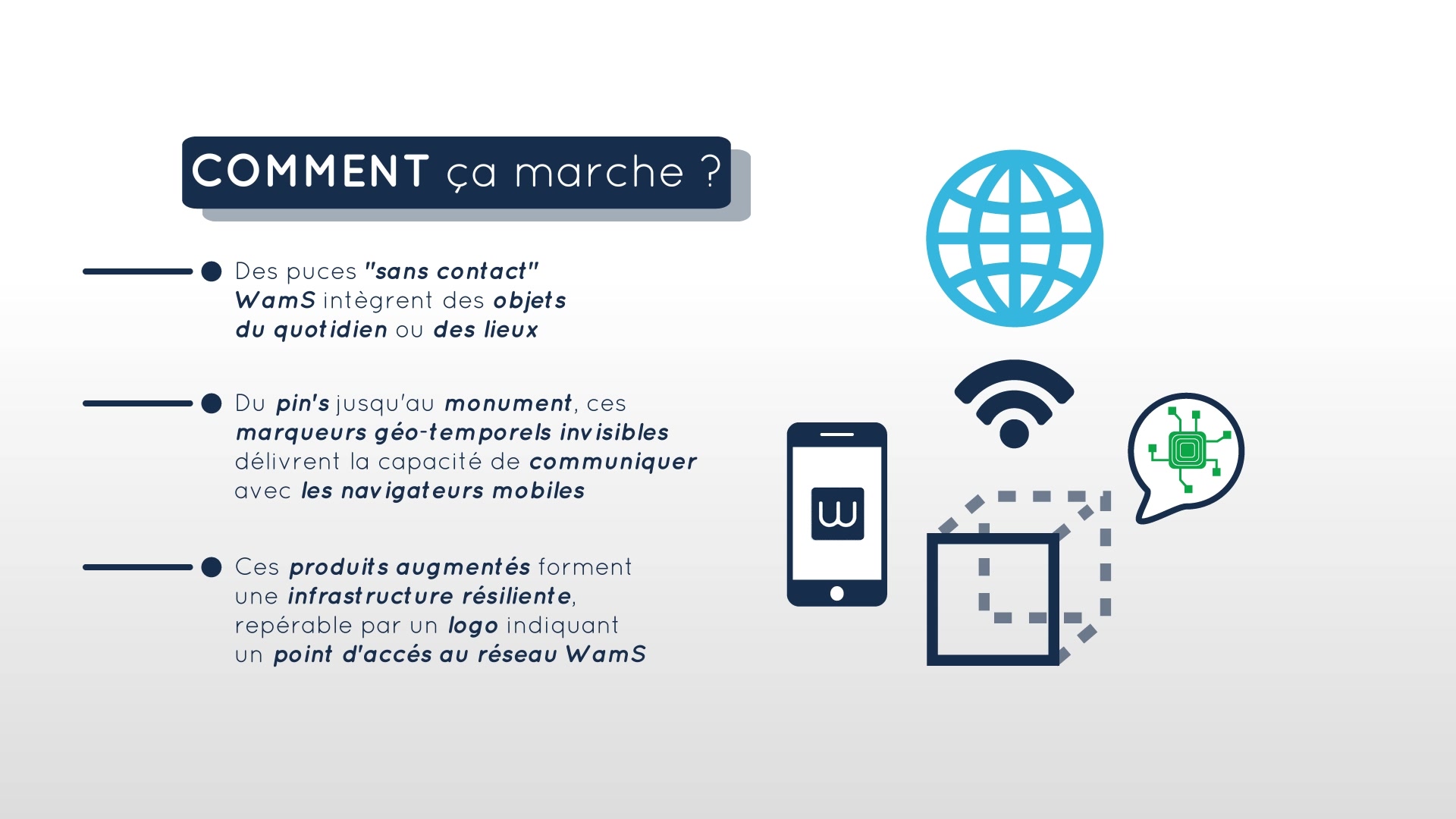
The concept fits in three lines — the ones I had written on the slide that won over the jury:
- WamS "contactless" chips embed themselves in everyday objects or places.
- From a pin's badge to a monument, these invisible geo-temporal markers deliver the capacity to communicate with mobile browsers.
- These augmented products form a resilient infrastructure, identifiable by a logo signaling a WamS network access point.
Seen from 2013, it was IoT augmented with NFC. Seen from 2026, it is the 1:1 scale model of the Protocol: sovereign objects, carrying their own digital identity, capable of transmitting without a server.
The DRACINNOVE prize
The project was presented to the DRACINNOVE jury, organized by the Communauté d'agglomération Dracénoise in Draguignan, under its original name AMIO. It is a regional innovation prize — not a global tech competition. But it was my first public and institutional recognition on the phygital question. The jury awarded the Jury Grand Prize. The project would then be renamed WamS for its deployment.
The effect was not material. It was permission-granting. It validated that a narrative I had been carrying for over ten years — since the 2001 patent on sovereign 3D avatars, since the 2003 Imagina Monaco conference — could exist in the real world without remaining an engineer's dream. The 2026 Protocol patent begins on that day, in 2013, in a room in Draguignan.
Thirteen years between the first public recognition of the phygital gesture and the filing of the patent that codifies it legally. Not from slowness — from maturation. Each proof of concept between 2013 and 2026 added a brick.
Why WamS did not industrialize
Honestly, because the market wasn't ready. The Internet of Things in 2013 was dominated by centralized platforms (Google, Amazon, Apple, later Samsung and Xiaomi) that absorbed every conversation about connected objects. The word "sovereignty" applied to an object had then no commercial or political traction whatsoever.
But the digital sovereignty narrative matured over the following decade: GDPR (2018), Cambridge Analytica, platform monopolies, generative AI eating everything. Today, the idea that a material object could carry on its own a part of the digital transmission is no longer exotic — it is a civilizational necessity. WamS was ahead of its time. The Protocol arrives on time.
From WamS to the Protocol — the phygital lineage
Between 2013 and 2026, I built a succession of proofs of concept:
- NFC supports anchoring digital works — the matrix of the future RELICKEEPER card;
- Direct offline transmission architectures — the mechanics of the Protocol;
- Memory objects with transgenerational lifespan — the goal of Sovereign Reality.
None of these pieces could have been patented alone. It is their coherent composition, as claimed in patent FR2607321, that constitutes the protected core. But this composition would never have been imagined without WamS as an initial matrix. The shape of the 2026 Protocol was already visible, as a watermark, on the 2013 DRACINNOVE slides.
What remains of WamS
The project itself was not industrialized. WamS chips are not on monuments — not yet. But the gesture survived: today, every RELICKEEPER card is, functionally, a direct descendant of the WamS geo-temporal marker. With everything that thirteen years of R&D bring on top: sovereign transmission, the legal patent, the Sovereign Reality philosophy.
The 2013 DRACINNOVE Grand Prize remains, alongside patent FR2607321 in 2026, one of the two dates that open and close the phygital arc. .//.